On motivation and service
July 11, 2025
One conversation that regularly circulates among all my founder friends is one of motivation - are you passionate about what you're working on? What's the goal, 10m ARR then exit? How much are you looking to make?
These are all variants of a deeper question: why are you doing what you are? And there seem to be two prevailing themes.
- Do something that will make you money
- Do something you are passionate about
I want to add a third and explore their failure modes.
Do something that will make you money
This is usually framed as a set of ideas that have a fast route to exit. Imagine your canonical Saas company that solves a real problem but at its core is uninteresting (e.g. clunky payroll software). The model is simple: find a good idea, build an MVP, find PMF and then sell to an incumbent. The founders passion for the idea is an irrelevant variable. Sam Altman calls this the deferred life plan; get rich, then pursue what really matters.
These businesses aren't necessarily boring from the outset. If you are curious by nature, these ideas lure you in. Problems are exciting for entrepreneurs, especially if it is big. There are also entrepreneurs who can obsess over any type of problem. Scott Cook of Intuit has famously built a multi-billion-dollar business obsessing over accounting software.
It is also true that momentum is a great drug that solves many problems. That is to say, if your HR software company is growing really fast, you probably won't care about how interesting the idea is or how passionate you are.
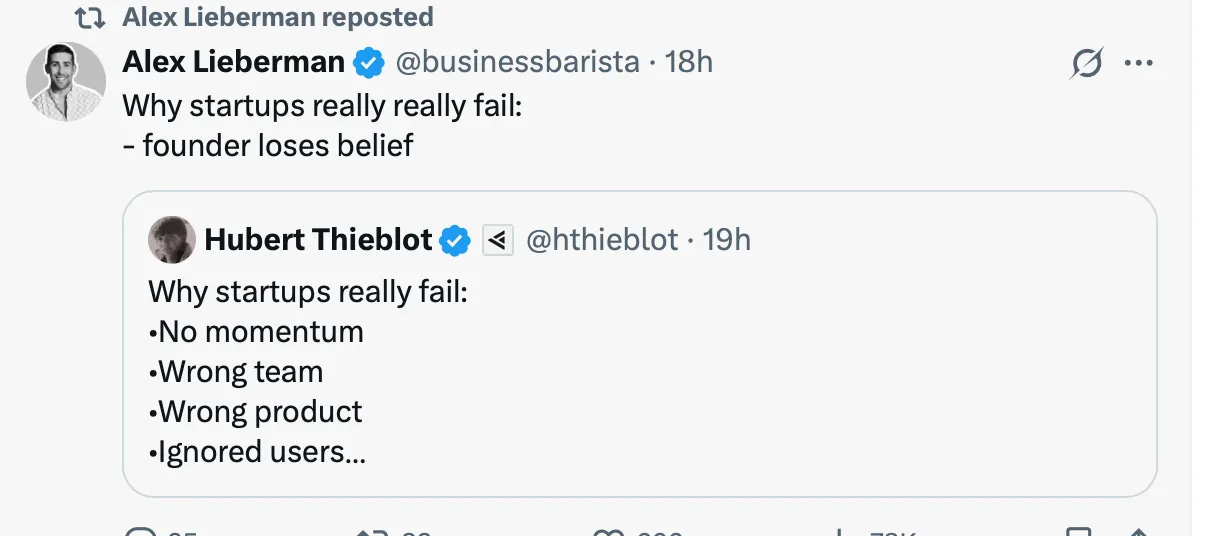
However, the 'make money' model fundamentally misunderstands a core characteristic of starting a company; it is almost always hard. The hardness of a startup is also not a constant; it's a series of brutal, unpredictable shocks. The idea that "once I get here, everything will be fine" is almost always untrue. At some point, one of the shocks can overwhelm your resilience and result in a "falling out of love" with the business. Like a romantic relationship, you can try and explain all the things that annoyed you, but at a deeper level, you just didn't love it enough.
Do something you are passionate about
This is usually framed as the solution to the first type of business. Passion is a forward-looking indicator of belief, and belief is what gets you through a period of intense hardship. It is a substitute for momentum. When you are in the trenches, it is your belief in the mission that keeps you going.
Paul Graham writes about this in his essay "How to do great work," but calls it interest. He provides a simple test to measure one's interest: Does the idea or field get progressively more interesting the more you explore it? If so, you are on to something.

This methodology assumes you are of a certain character type: a specialist, someone who can be obsessed with a single domain for years. However, for many, passions change and evolve. Generalists can find passion in lots of areas, but maybe not a deep passion. They can become intensely interested in a subject, say for 6-12 months, long enough to get a company off the ground, but find that interest wanes over the years.
This is a problem - if you are a generalist, there is a much higher risk you start something and misjudge your passion for it, leaving yourself in the same situation as option 1. The model fails because your motivation, while intrinsic, was brittle.
Do something of service
The core issue with the first two methodologies is that they rely on a source of motivation that can change. They are built on the unstable foundation of the self. Motivation based on extrinsic rewards or internal feelings is brittle because the self can be fickle. The question that is left is, where can a generalist find enduring motivation? What is a fuel source that stands the test of time?
One answer is to anchor your work to a purpose outside of yourself, a principle of service. This simple shift from an internal to an external focus is the key to unlocking durable motivation.
I define service as a dedication to a cause bigger than oneself. The process of service is deeply nourishing to the human soul because it is intertwined with sacrifice; that is, to pursue this cause, you have to give up something yourself.
When you are in service, sacrifice is no longer a bug; it's a feature. You are trading a lower-order good (your comfort, your time, your ego) for a higher-order one (meaning, purpose, connection). This is why it feels "nourishing."
To be of service is to partake in the process of creation, for creation's sake. Will Manidis writes 'The LORD God places man in the Garden of Eden "to dress it and to keep it" (Genesis 2:15) establishing labor not as punishment but as sacred vocation. This original calling invites us to co-create the Kingdom, tending and developing the world with intention and care. Our fundamental purpose is not consumption but participation in the ongoing work of creation.' In a more secular sense, work becomes nourishing because it aligns with a fundamental human need to contribute - to "tend the garden" rather than just consume its fruit.
This theme of service, sacrifice, and creation is apparent in all great founders. Yvon Chouinard spent fifty years building Patagonia, a company defined by its quality, only to give the entire thing away. This final act proved his life's work was ultimately in service to a cause—the preservation of our planet.
Whilst it feels nice to end an essay on a conclusive maxim, delivered through a campfire story of Yvon Chouinard, it would also be disingenuous. Whilst service is the most attractive form of motivation for me, founders don't always have the luxury of prioritising a calling of service, and for many, it simply isn't the most powerful fuel.
The true goal here isn't to persuade you on the "best" method, but to illuminate the failure modes of the most common. Because on some level, every founder battles with these motivations, drawing on them at different moments. Life is messy. The real problem isn't that founders are unaware of these fuels, but that they lie to themselves about which one is most suitable for them.
The best we can do, then, is practice a kind of radical self-honesty about what type of person we are and what is most likely to sustain us for the long term. It is this clarity that keeps the path true and ultimately plots the course toward a founder's holy grail: the nexus of long-term fulfilment.